
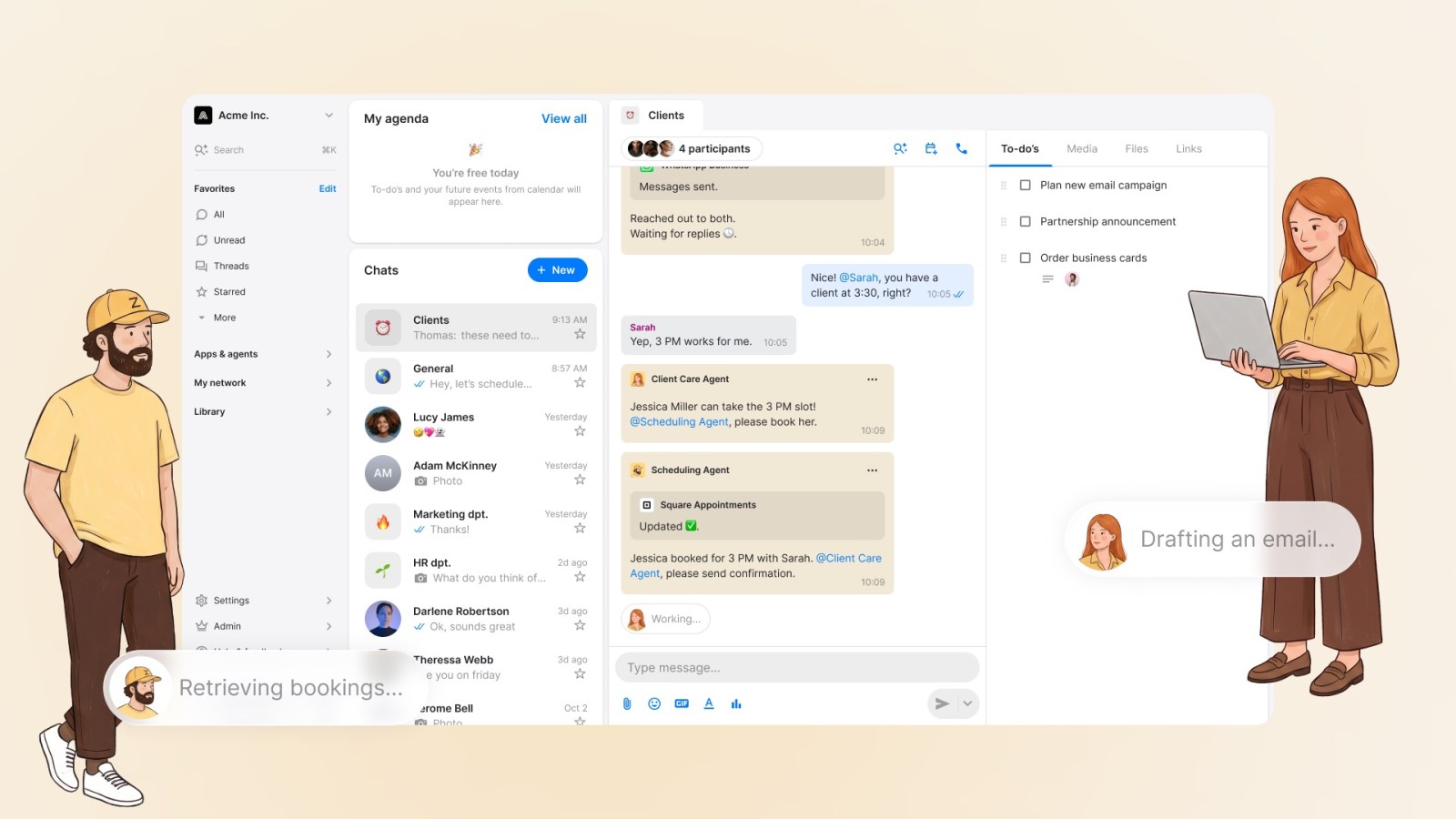
Many companies worldwide rely on consumer messaging platforms such as WhatsApp, Telegram, Discord, or iMessage to communicate with employees, coordinate tasks, and share files.
Guy Weiss has created Zenzap, a secure private messaging app powered by AI, designed to enable businesses to interact with their workforce and provide contextual information while adhering to IT and security policies.
Zenzap secured $44 million in a funding round led by Bessemer, Lightspeed, and The Garage, with additional participation from Wix president Nir Zohar and former EY managing director Yoram Tietz.
This financing is notable because it marks Weiss’s inaugural capital raise. Previously, he self‑funded the e‑commerce marketing platform StuccoMedia in 2012, sold it to Market Group in 2015, and then invested for several years before launching Zenzap in 2022 after collaborating with Bessemer partner Adam Fisher and his co‑founders Noam Neumann and Jonatan Bien.
Weiss explained that he originally funded the app himself and operated from Bessemer’s offices. “I never wanted to seek external funding; the only risk was my reputation, and I was terrified of a second fundraising round that could label me a failure, especially after a successful first round. I didn’t need outside money, so when I met Adam, I launched the concept using my own capital,” he told Techdaily.
Fisher persuaded Weiss that Zenzap ought to be venture‑backed, given the substantial capital required for scaling.
He explained that the goal is to develop a messaging solution applicable across diverse sectors, including hospitality, construction, healthcare, and fast‑food.
“WhatsApp or iMessage cannot be used in a corporate environment with an AI layer because they don’t meet IT compliance standards, making them unsuitable. Likewise, Slack and Microsoft Teams weren’t designed for a mobile‑first, everyday user experience, so they’re not appropriate either,” Weiss noted.

Zenzap provides standard chat functionalities on its free tier — group and direct messages, task management, calendar and schedule integration, plus AI‑driven voice chat and search. Paid plans begin at $51 per month for up to 20 users, unlocking voice and video calls, intelligent task sorting, templates, expanded file storage, workspace‑wide AI search, and the ability to convert messages into tasks.
The firm also supplies AI agents for workflow automation and AI‑enhanced voice note and call transcription, which are billed on a credit‑based pricing model.
Currently, Zenzap counts clients such as FedEx, Dollar General, Taco Bell, Starbucks, Casey’s, and Regal. Weiss noted that fast‑food chains like IHOP and McDonald’s use the platform to coordinate shifts and discuss supply logistics.
“Every sector has distinct use cases and workflows that they manage via AI, yet they all share a common requirement,” he said.
The startup currently employs 50 people across the U.S., Tel Aviv, and Europe, and plans to expand its team by hiring in product and R&D roles soon.
Bessemer partner Adam Fisher said Zenzap’s broad‑appeal approach could be advantageous, noting that his own firm uses the messenger internally to discuss and manage deal flows, demonstrating its suitability for various audiences.
He added that the only work platform with any allegiance is Slack, which is primarily used by developers, while Zendesk targets the vast majority of employees who rely on personal messaging apps and await their own agent. People desperately want a clear separation between work and personal life, and the rise of personal and work agents makes this separation imperative now,” he told Techdaily in an emailed statement.