
Recalls can be extremely costly. A notable example is the recall of every Chevy Bolt produced between 2017 and 2022, where a problem at an LG battery factory led to improperly installed parts inside the cells, ultimately costing LG $1.9 billion.
Major manufacturers across various industries frequently face recalls. In the electric vehicle sector alone, companies like Volkswagen, Stellantis, Hyundai, and Toyota have experienced such issues.
“The majority of those major quality issues could have been caught with CT scanning. And the reason why they weren’t is because it’s way too slow to do any kind of statistical sampling,” said Eric Moch, co-founder and CEO of Glimpse, in an interview with Techdaily.
To help companies identify more defects, Glimpse has developed a solution that enables battery manufacturers to inspect cells 10 to 30 times faster by significantly increasing the throughput of their existing CT scanners. Using Glimpse’s software, manufacturers could scan tens of thousands of cells per day, up from the current handful, according to Moch.
A “super scanner” that Glimpse is developing with partners could complete a scan in just one or two seconds, he added.
Batteries are not the only components prone to costly defects, so Glimpse is launching a new product, the company exclusively told Techdaily. Named Explore, the product will allow customers in industries such as aerospace, automotive, electronics, and medical devices to use the startup’s image processing software to accelerate quality control checks using CT scanners in their labs and development environments.
Glimpse currently serves over 100 customers, including Anker, Lucid, and the U.S. Navy, and generates mid seven-figure revenue, said Moch. The customer base includes both buyers and sellers of batteries.
To enhance the speed of traditionally slow CT scanners, the startup has developed its own image processing pipeline, which compresses and cleans up scans. The pipeline is built around deep learning algorithms, with much of the initial processing occurring on edge computers deployed at customer sites. “It does all of the heavy lifting before sending the output to the cloud,” Moch said.
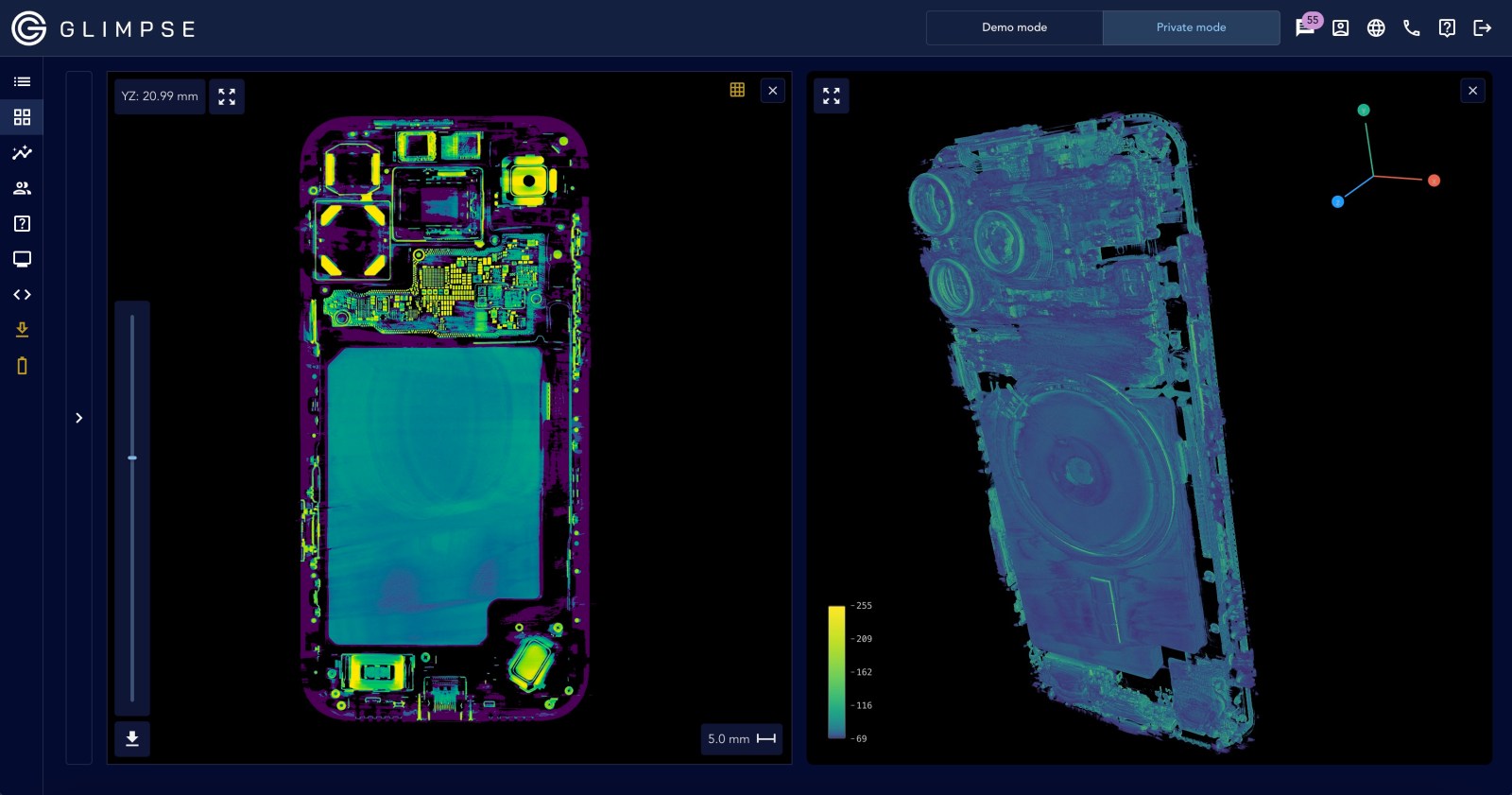
The combination of quality improvements and compression results in clear images that load within seconds in a web browser, the company claims. “You don’t have to wait minutes or even sometimes hours for that data to load,” he said.
In addition to scanned images, Glimpse’s dashboard will display part measurements specified by customers. For batteries, this might include the distance between layers in a battery cell.
If these measurements start to deviate from the norm, Glimpse’s software will flag and highlight them in the scanned images. “They can see with their own eyes the defects that they care about,” Moch said.
The deep learning algorithms also take into account customer input, retraining themselves along the way.
Customers without their own CT scanners can ship parts to Glimpse, which will use its own CT scanner in the Boston area. The company is opening a second Scan On Demand center in the San Francisco Bay Area.
“We expect this scanning service to actually be a bigger market. You can spend a couple hundred bucks or a few thousand dollars on Glimpse, and you don’t have to buy a very expensive piece of equipment,” Moch said. “And one day, when it makes sense for you, you buy the scanner and then you run our software on top of it.”