
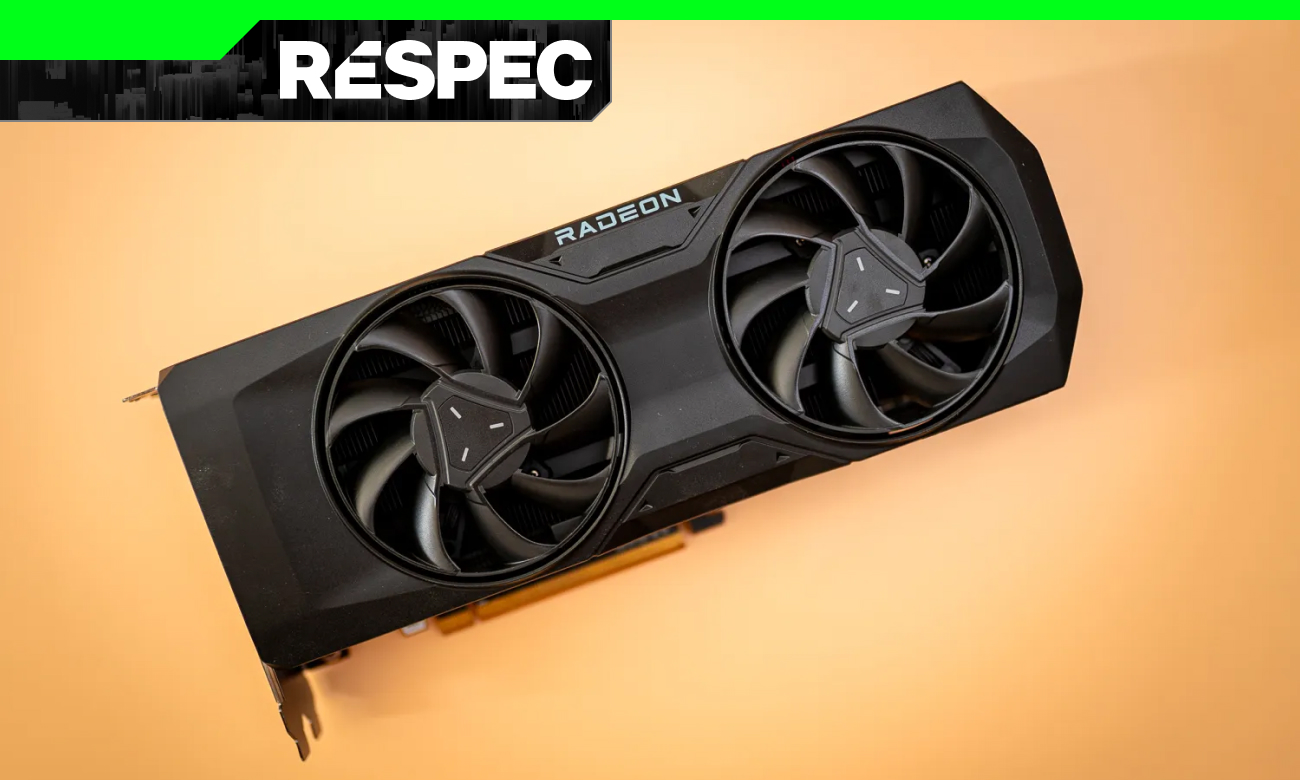
AMD’s current-gen graphics cards have been a revelation. Last generation, AMD was able to hit performance parity with Nvidia while sacrificing ray tracing performance. This generation, AMD is maintaining parity while getting closer in ray tracing, as showcased by GPUs like the RX 7900 GRE. But the next frontier of gaming is rapidly approaching, and AMD’s current options aren’t up to the task right now.
I’m talking about path tracing. Nvidia calls it “full ray tracing,” and it’s a lighting technique that can take gaming visuals to the next level. Path tracing is only available in a small list of titles right now, but with frame generation and upscaling tools better than they’ve ever been, it won’t be long before we see these destination gaming experiences everywhere.
Player two in path tracing
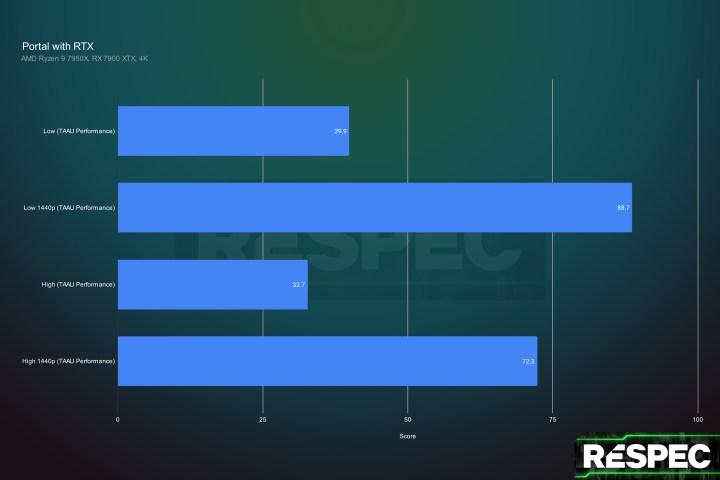
Nvidia has path tracing cornered right now. Better ray tracing and smart deployment of DLSS 3.5 has earned Nvidia a dominant position in the few titles that support path tracing. Portal with RTX is a prime example of that. Even at low settings and using the relatively ugly Performance mode of TAAU — basically AMD’s FSR 1 — AMD’s fastest GPU can only manage just shy of 40 frames per second (fps) on a 4K monitor.

Get your weekly teardown of the tech behind PC gaming
High settings are even worse. You can step down to 1440p to get frame rates above 60 fps, but it’s important to remember that this performance is with TAAU turned on. It doesn’t look great, and you’re just barely getting over the line of playable performance, even on a GPU as powerful as the RX 7900 XTX.
For a game like Portal with RTX, this is the ceiling for performance that AMD currently offers. Even the driver-based AMD Fluid Motion Frames (AFMF) won’t work with Portal with RTX — the game uses Vulkan, which isn’t currently supported. Meanwhile, Nvidia’s RTX 4080, which is slightly slower than the RX 7900 XTX on average, can hit 86 fps with DLSS 3. That’s with the ultra preset, too.
Portal with RTX isn’t the only game with path tracing. The two other big titles are Cyberpunk 2077 and Alan Wake 2. With AFMF available now, I was hoping that AMD would be able to get over the line in these games. There are still some problems, though.
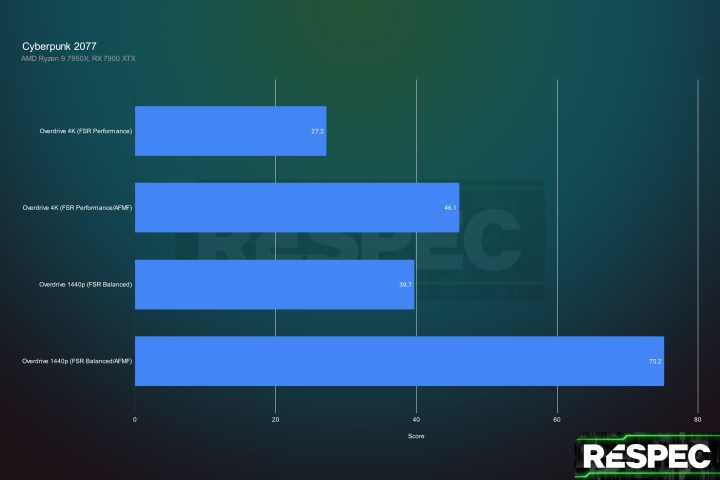
Looking at Cyberpunk 2077, you can’t get to a smooth frame rate at 4K, even with FSR set to Performance mode and AFMF rolling. And while 1440p is possible, and with the better-looking Balanced preset of FSR, it’s still not a great experience.
As I wrote about previously, AFMF has some issues when it comes to motion, making performance feel inconsistent even if the average frame rate is high. Cyberpunk 2077 might be possible on AMD’s current-gen lineup when it receives frame generation with FSR 3, but still probably only at 1440p. That’s not where you want to be with a GPU that can easily cost $1,000.
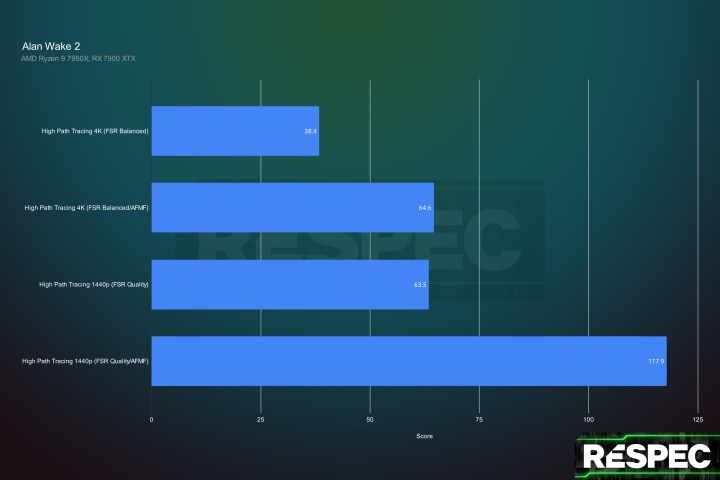
Alan Wake 2 was much better, but I still wouldn’t call the experience at 4K playable. With the low base frame rate at 4K, even with FSR 2 set to Balanced, AFMF doesn’t have enough information to provide a smooth experience. Fortunately, 1440p was much better, not only due to the high base frame rate for AFMF, but also because I was able to bump FSR up to its Quality mode.
Across all three games, though, the experience wasn’t good. I was able to achieve playable performance in all three titles, but not without some significant hits to image quality. Meanwhile, even a GPU like the RTX 4070 Super can play Portal with RTX and Cyberpunk 2077 at maxed-out settings thanks to DLSS 3 and better overall ray tracing performance. AMD could compete more if these games supported FSR 3, and some of them will eventually. That’s not the case right now, however.
A key focus for the next generation

In the next generation of AMD graphics cards, path tracing needs to be a critical focus. That will come with better overall ray tracing performance, but also through robust FSR 3 support — something that I’ve been hammering on the past few months. It’s not that every game will support path tracing, but for the handful that do, it can make all the difference.
Over the past year, titles like Alan Wake 2 and Cyberpunk 2077: Phantom Liberty have been destination games. You buy an expensive GPU just to experience all the glitz and glamor in these titles, even if the card is overkill for most other games you want to play. As it stands now, Nvidia is the only one delivering that prestige gaming experience — even with AMD’s absurdly powerful RX 7900 XTX, there are a lot of compromises in these demanding games.
AMD has some compelling options lower down the stack. The RX 7600 effectively nullifies the RTX 4060, and there’s some serious competition between the RX 7800 XT and RTX 4070. Even in the range of higher-end options, AMD has put serious pressure on cards like Nvidia’s RTX 4070 Ti Super with its current-gen options.

The main problem here are the flagship cards. When you start spending up, you want to have all of the bells and whistles, and AMD is struggling on that front. The raw performance is competitive, but ray tracing and features are not, which is a tough compromise when you’re spending so much money on a graphics card.
AMD is well aware of the ray tracing gap with Nvidia.
This should be an area where AMD focuses on in the future, however. We currently expect to see AMD’s RDNA 4 graphics card in the second half of this year. The release date is fluid, with some leakers pointing to late summer and other suggesting the cards will arrive in winter, but it seems like RDNA 4 will launch at some point in 2024.
AMD is well aware of the ray tracing gap with Nvidia, too. Former Radeon manager Scott Herkelman said, “we just have to do better on future generations” in reference to ray tracing, pointing out the fact that AMD undercuts Nvidia’s pricing due to the ray tracing gap.
In addition, leakers like Moore’s Law is Dead claim that AMD is “going to go hard for ray tracing” in future GPU generations. That’s certainly the trajectory AMD has been on, with the current generation being a bit of an inflection point.
Signs are positive, but some leakers suggest AMD is abandoning high-end GPUs with its next-gen options, and instead focusing on midrange GPUs where the vast majority of PC gamers live. This is speculation for now, but if it’s true, high-end experiences like path tracing in games don’t seem likely if AMD focuses on the mainstream in the next generation.
Regardless, it’s an area AMD needs to address sooner rather than later. We already have a few example of how path tracing can transform the look of a game with Alan Wake 2, Cyberpunk 2077, Minecraft RTX, and Portal with RTX, and I suspect we’ll see more games supporting the demanding lighting tech in the future. It won’t be every game, but good performance in these prestige titles will continue to be important for flagship offerings.